

I believe Andy Jassy coined the phrase, “There is no compression algorithm for experience.” Generally speaking, I agree. However, I do think that there might be a way you could cut down the number of years it would normally take to become a competent, well-rounded product development leader who can scale. A competent leader who can -
Hire and retain the best, manage out the rest
Knows how to execute through their teams, can delegate effectively
Knows how to manage up and sideways
Can create team-specific goals that ladder up to company goals
Can easily scale themselves
And that would be to work for a (or a few) startup—not any startup, but the right one. This post is about what types of startups are best suited to learning quickly and why. Before I begin, the intended audience for this post is product and engineering leaders who want to build a career in leadership and management. Lastly, when I refer to a ‘leader’ in the post, I use it interchangeably with product and engineering leaders.
Before I get into the meat and potatoes of this post, here is a rough career arc for leaders who want to accelerate their learning and growth.
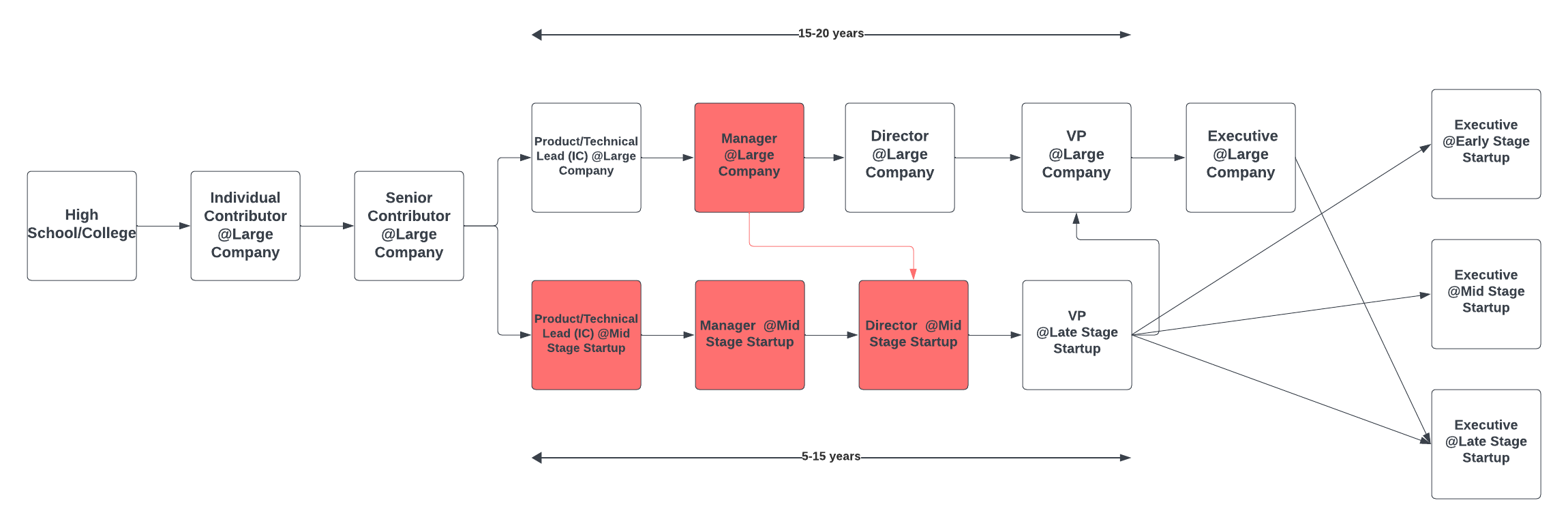
A few things to note about this career arc
Yes, I recommend starting your career with some experience in a large company. Large companies have solved most of the problems that earlier-stage companies struggle with, so they are a great place to start your career and learn the basics.
The arrows represent role changes. These role changes could be within the same company or a different company.
The salmon-colored role jumps in the chart above are what I think will enable dense learning in a compressed time frame and outsized role jumps in a compressed time frame.
Staying at a large company is definitely less riskier than jumping around earlier-stage companies. However, when the jumps are made into the right roles and the right companies, the reward will be dramatically more meaningful, assuming the company doesn’t go kaput.
Executives from large companies typically don’t do well in early- or mid-stage startups, hence the lonely arrow in the final box in the top row.
I don’t mention any early-stage companies in the arc, and that is by design. Early-stage startups are great for learning a whole bunch of things at the same time, but not for leadership and scale skills. Don’t get me wrong; early-stage startups are great for a lot of things, including the potential upside of an exit, but they are not great places to build a leadership/management career.
The Goldilocks Zone
In general, early-stage startups (from pre-seed up to Series A) are poor candidates for learning how to become well-rounded leaders. There are a few factors. Early-stage startups are all about trying different things until the team finds the almost mythical product-market fit. All this experimentation prevents leaders from building deep expertise in their areas. Additionally, early-stage companies are small. If the R&D team is under 20, one can’t really build any skills around hiring, scaling themselves, etc.
Surprisingly, I found that late-stage startups (R&D team size > 100, post-Series D, and pre-IPO) are also poor candidates for fast learning. The only caveat here is if you were hired to run a department or are joining as a very senior leader (Director+) with a lot of influence. Even though the size of your team might be larger than that of the early-stage companies, so will the number of competing leaders in the company. Late-stage startups tend to beef up their leadership bench as they prepare themselves for scale. So, most product and engineering leaders working at these late-stage startups become medium-sized fish in a big pond with only marginally more responsibility (or maybe even lesser) than they had at an early-stage company. Additionally, as the number of new leaders grows, so does the potential for culture clashes, nepotism, etc. Lastly, late-stage startups have most likely already figured out most of the scale-related problems (outlined in the next paragraph), so at the most, you might be able to influence the existing mechanisms to a certain extent but won’t be able to create it from scratch like you would at a mid-stage startup. All of the above makes it harder to learn quickly and advance your career.
A line manager or a Director at a Series B, Series C, or Series D company (R & D team size < 100) is the best place to quickly learn core leadership competencies that will enable you to make outsized role jumps in the future.
This is where you will be pulled into (or maybe even directly responsible) high-value (and high learning potential) activities like-
Defining career ladders
Define hiring policies
Hiring other leaders to scale yourself
Helping create company goals
Helping create department-level goals
Helping create department-level roadmaps
Creating processes and mechanisms to track progress against goals
Direct access to the executive team (and potentially even board members) and customers
These high-value activities are not super useful for very early-stage companies, so they tend not to do any of them. Conversely, they are extremely important for late-stage startups, but they are typically done by the executive team with little input from the rest of the rank-and-file leadership. Mid-stage startups are (IMO) the only companies where mid-level (Director) and line leaders (Manager) can directly engage in these high-value/high-learning activities.
Suppose you are a line/mid-level leader at a mid-stage startup. In that case, you will most likely report directly to the C-level (CEO, CTO, CPO, etc) executive, which really accelerates your learning (assuming the executive knows their craft), boosts your authority, and gives you direct insight into the inner workings of the company and lastly, allows you to influence neighboring departments like support, sales, etc. which you normally wouldn’t be able to do at a late stage startup. And yes, you will report to a C-level executive at an early-stage startup as well, but the difference will be the experience of the executive in charge. Early-stage C-level executives will most likely be either founders or leaders who were promoted on the battlefield. Mid-stage startups on the other hand are typically run by executives who have seen scale. And sigh, yes, you will be able to report to an experienced leader at a late-stage startup, but the chances of your direct leader being an executive are lower than in a mid-staged company. Whew, that was a mouthful!
However, not all mid-stage companies are built the same way. Mid-stage companies with the following attributes are the ones to seek out-
Annual revenues of greater than 30M but less than 100M
The sales/revenue is predictable. A predictable revenue curve is a sign that the company has hit product market fit. Be vary of hockey stick curves or spiky growth. That means either the company is still in its early stage, or it is a mid-stage company that has introduced a major change (new product, changed pricing, etc) that caused its revenue to jump. Obviously the latter is a preferable scenario than the former.
The founders are still there and easily accessible. There is no easy way to learn the nuts and bolts of building a lovable product besides learning firsthand from the founders.
The non-founder executives are experienced leaders who have seen scale before.
Be vary of more than one layer of management between you and the C-level executive. The ideal chain should be CEO->CxO->You. CEO->CxO->VP/Director->You is still fine but less desirable than the former.
Look for companies that have a Head of People. A lack of a chief HR person indicates that the company is at an early stage.
Companies with real problems to solve versus the ones scaling up because their investors told them so
Stay away from private equity-backed companies.
Lastly, the playbook I outlined above is not exactly a science but an informed opinion formed by my own experiences and observations. Individual mileage may vary :) If you are looking to make a career/role and want my opinion/advice, don’t hesitate to reach out at sensibleexec@gmail.com or connect with me on LinkedIn. If connecting over LinkedIn, don’t forget to add a quick note explaining what you are looking for.
That is all for now folks! If you have additional comments/observations, drop them in the comments!
P.S - If you enjoyed reading this post, consider sharing it!
Mahesh, could you expand on 'Stay away from private equity-backed companies.'?