

Most companies have to fight for a long time to start generating meaningful, stable, recurring revenue. It takes years of research, getting the product right, understanding their customers, and fine-tuning their go-to-market motions to get to a place where they can go; whew, we made it! We are building something valuable for our customers that they are willing to pay for. Huzzah!
Along the way to getting there, people's careers are made. Individual contributors become managers, managers become executives, executives become CEOs, etc. These people are deeply proud of what they have achieved, not just for their business and customers but for themselves. They now know how to win. They have well-defined playbooks that have been refined over many years to teach new employees how to win. New employees learn from this playbook and generate more wins for the business. Everybody is happy. Employees go to retreats, there are big bonuses for everyone, and employees are buying their first houses. Prosperity everywhere. However, it won't last.
Every company's growth curve looks something like this:
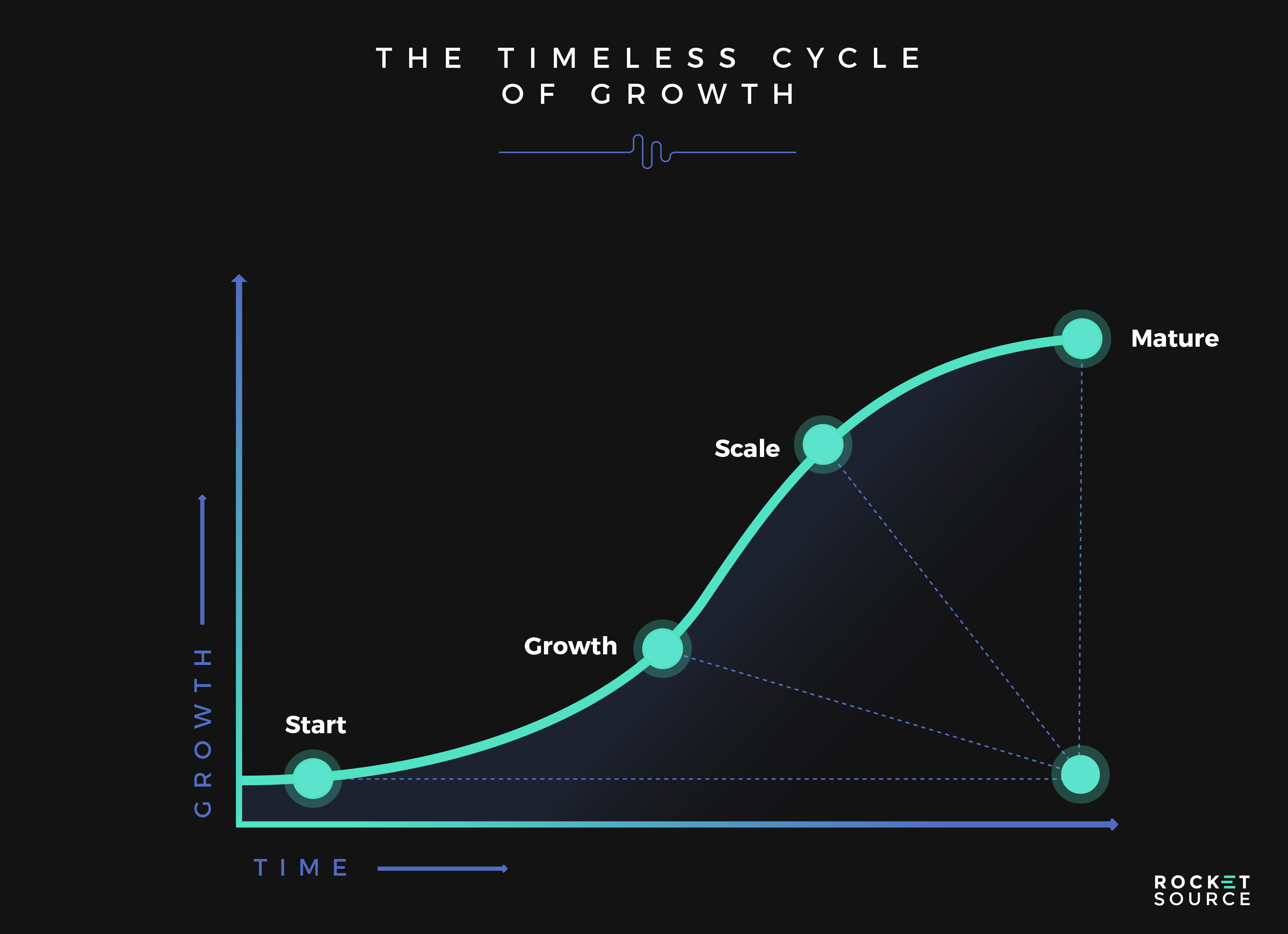
When they hit true product market fit, it kicks off their growth. After this, companies will double down on a specific channel, acquire more customers, and scale their growth. But scale is not infinite. At some point growth will plateau. This happens mostly for one major reason. Most companies are single-product companies. It isn't their fault, though. Every company has to start with a focus on meaningfully (and delightfully) solving one problem for customers. But once they get addicted to success, it is hard to stop. For venture-backed or publicly traded companies, the pressure to drive growth and revenue is intense. To be clear, I am not implying that companies stop building new features for their customers and just focus on sales. They continue to build features within the problem space they originally found product-market fit in and sometimes solve adjacent business problems, but most likely, for the sake of revenue predictability, they will stay in their lane.
Most companies can do this for about ten years. After ten years, their growth curve will plateau. It won't matter how many new features they build or how many discounts they give out, it will feel like getting to the glory days of 40% growth are gone. There are a few reasons for this. First, companies cannot solve for the entirety of the customer journey. Most companies don't have the capital to do that. They will pick a part of the customer journey and do it better than others but let others solve for the rest of the customer journey. If it is a deep enough customer journey (e.g., online shopping), multiple companies will solve for multiple parts of the customer journey. Some of these companies will do a really good job, win the hearts of customers, and find their own product market fit. Some of these companies might be very small companies that can move faster. Or they have a lower cost structure because their staff works out of a lower cost location. What do you think this smaller company will do once they have solved their problem space? How will they grow? They will start moving into the space of the incumbent and start competing with them for their customers. The incumbent is now caught completely off guard. The contender can move faster than them, has a lower cost structure, and has the same momentum the incumbent once had ten years ago when they were smaller. The incumbent's growth eventually plateaus, as you can see in the graph above. I started this paragraph by saying it takes ten years for most companies to start plateauing. Ten years is also how long it takes most successful companies to go from a startup to a quickly scaling company. So, in ten years, the small startup has now become a formidable competitor, eating away at the growth of the incumbent.
So what now? The incumbent is now facing intense pressure from all sides. The smaller company that they thought was irrelevant is eating away at their business. The board is pressuring them to grow or cut costs. The employees are all worried about growth. So what does the incumbent do? They go back to their playbook. They deeply understand their customer journey. So they try to build more features faster. They try to undercut the competition. The management tries to rile everyone up in the company against the competition. Managers will ride their teams hard and get them to burn the midnight oil and hit all deadlines. However, I think all of this will only yield minor, short-term wins.
I believe that once companies start to compete on the basis of the same (or mostly similar) set of features and their associated prices, it becomes a zero-sum game.
Look at what is happening in the LLM battle. OpenAI, Google, Amazon, and Meta are fighting for dominance over the same broader use case. Very soon, this will become a race to the bottom. Remember the cloud wars from ten years ago?
When companies try to fight each other for the same set of customers over the same set of features, there will be only losses on both sides. When the sharks fight with each other over the same patch of food, the water will turn bloody very quickly. The solution is to find a path to a new set of markets and customers. A new problem to solve for maybe a new customer base. A new market where there is very little competition. A blue ocean. Amazon giving birth to Kindle when everyone (investors, the market) wanted them to compete with digital music is a masterclass in swimming to a new blue ocean.
However, it isn't enough to just pick a new problem space and hope to win the market. Companies have to look hard at their strengths and weaknesses first. They have to look at their strengths and determine whether their current strength would be an advantage in the blue ocean. Amazon wouldn't have been successful in bringing AWS to life if it didn't already have world-class, scalable infrastructure and a world-class engineering team.
Additionally, if the company decides to enter a new blue ocean, they have to sufficiently differentiate themselves from the competition, or newer, smaller contenders will just replicate that move. When moving into new markets, the key is to figure out how to create a moat around you that will enable them to scale in the new market. A moat that is hard to cross.
First movers advantage can be a great moat, but albeit not a 'forever' moat. First-movers can be defeated over time if they fail to innovate. Case in point: AWS. They enjoyed (and still do to a great extent) a monopolistic environment for a very long time, but now Azure and Google Cloud are eating into their market share. It will be interesting to see how AWS competes long term because it is clear that the market has assigned the following to these three companies.
AWS - Most mature feature set
Azure - Second most mature feature set, plus access to enterprise LLMs, via OpenAI
Google Cloud - More fully managed solutions and can be aggressive about undercutting others on cost. I have never seen companies switch to AWS or Azure for the reasons of cost savings, but I have seen them move to Google Cloud for saving money.
Having an aggressive work culture cannot be a moat, either. I have seen companies drive their staff to the bone and push them to get features out faster, but getting stuff done faster cannot be a long-term strategic advantage. Primarily for two major reasons: 1) It is unsustainable for long periods of time. Even the 996 culture of China will tumble at some point, just like it did in Japan. 2) There will always be someone who can find cheaper labor and/or figure out how to get features out faster. 3) In the end, an aggressive feature-per-feature parity battle will only lead to a price battle. TikTok is an interesting outlier. They have a brutal work culture, and they have somehow held on to their dominant position as the app of choice for Gen Z's, millennials, etc. My theory is that TikTok is able to keep its dominant position because it is this generation's cigarette company. They know their product is addictive, and they actively try to get you more addicted. At some point, it will come crashing. The other social media companies know this as well, which is why they have been actively pivoting into other markets. Meta has pushed into VR, AI, wearables, etc. Same with Snapchat.
So, how does one find the 'moat'? I believe that the moat has to build on top of the company's hard-earned strength. Strengths could be its customer base, brand name, marketing reach, it's network, engineering, and product-related IP, etc. Kindle was such a huge hit because of Amazon's existing catalog of partially digitized books, and it also had buyers who were already buying books from Amazon. All Amazon had to do was fully digitize its catalog and make that catalog available to its existing buyers. So when someone bought a Kindle, they automatically had access to millions of books. Google Ads became so lucrative because of the popularity of its search engine. Uber Eats makes billions of dollars in revenue because it built on top of its existing network of riders and drivers.
The key is to identify your business model's strength and use that to vault yourself into a new line of business. Use your current powers and market position to jump out of the bloody ocean and into a blue ocean and leave the competition behind. This won't be easy though. It is very hard to give up your current focus area. Especially if that focus has been lucrative for the company. But trust me, every company has to execute this move if they want to survive in a bloody ocean.
Quick book update:
I am now drawing close to the first phase of my publishing journey, which consists of two rounds of copyediting followed by two rounds of proofreading. I just got started on the cover design, which means I am now in the production phase, which is very exciting. All in, I am looking at a few more months before it heads to the press. Oh, I also have a name for my book:
How to Deliver Bad News and Get Away with It
Needless to say, none of this would have been possible without your constant support, so thank you all!
If you enjoyed reading this post, consider sharing it!