

Most middle managers never make it to the C-Suite, a.k.a. the executive team that runs the company. There are two major reasons. First, there are only so many executive roles to go around at any given point in time, and most of those roles are never advertised broadly. Either they are filled internally, or companies rely on executive recruiters to find the right candidate. Second, most leaders don’t think like executives. There are many high-performing managers and directors who never make it to the executive team because they don’t exhibit the qualities that CEOs and board members look for in executives. In my experience, only about 10-20% of managers make it to the executive team.
In a previous post, we discussed the path to making it to the C-Suite, so I won’t discuss it here again, but just for posterity, here it is:
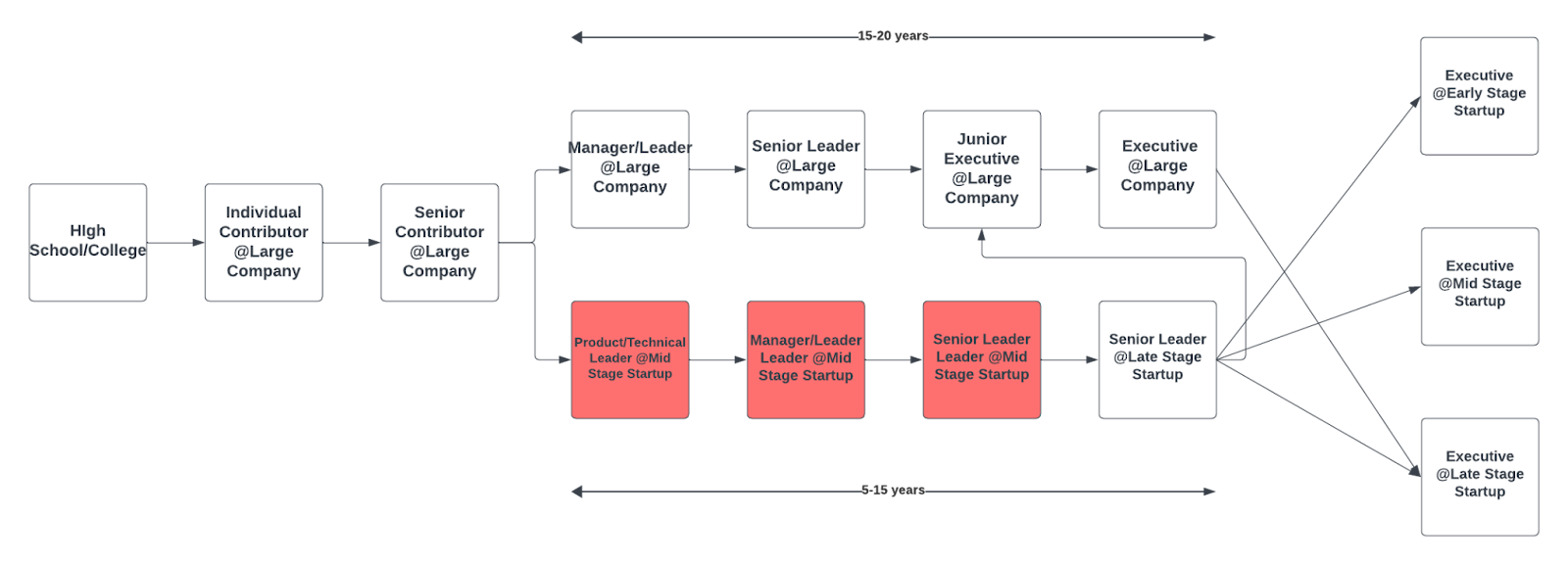
This post is all about what sets executives apart and how to cultivate that mindset. So, let’s get ready for some weirdness.
Mission Impossible
Executives will happily say yes to the most impossible of tasks. This is the number one trait lacking in most early career managers, middle managers and high-performing senior individual contributors that prevents them from getting close to the executive role. Most managers have been trained to say ‘yes’ only to projects and goals that they can hit either comfortably or with some extra effort because they know that not hitting those goals means they will get dinged in their review. So when someone asks them to take on a suicide mission, they will just say, ‘Yeah, that’s not possible.’
Executives are not there to take on comfortable tasks. They are hired to take on seemingly impossible tasks. Tasks like turning around an entire department's culture, turning around a company's fortunes, creating a new line of business, etc. They are almost exclusively hired to do the impossible. Here is the secret. What executives know is that with enough resources (time, money), support, and perseverance, anything is possible. They also know that as an executive, they don’t have to hit their goals 100% of the time. Technology companies and their executives take on aggressive goals, and they have to get closer each year. If they can accomplish their ‘impossible’ task in a few years, they are golden. How do you eat an elephant? One bite at a time.
To become an executive, you must get comfortable saying ‘yes’ to seemingly impossible tasks. One of my old bosses used to say, “Never start with a ‘No’ or a ‘Yes, but.’ Start with ‘Yes, and’”. For example, if your boss asks you to take on a massive project that will upend your roadmap completely, the correct response from you should be:
Start by being supportive. Your boss is imposing this massive project on you because they trust you. If you start with a “No,” it will send the wrong signal. Saying “No” a few more times will essentially kill your chances of becoming an executive in that company.
Understand their motivations. Take time to understand why your boss thinks this is important. This will show that you care about it as much as they do.
Give them options. Explain to them what you need to do to support their initiative. Remember that anything is possible with enough time, money, and perseverance.
Make the right decisions
Executives have an uncanny ability to make the right decision most of the time. They can do that because of the three skills they have cultivated.
First, they are extremely aware of everything around them. They know how the company makes money, they understand how their neighboring departments work, and they know about their competitors. They understand macroeconomic conditions and the internal and external political landscape. They understand all these complex business dimensions because they have taken the time to learn them. The most effective executives are extremely curious and can quickly consume an alarming amount of information and draw insights from it. To an executive, constantly consuming information and making sense of it is a habit; if you aspire to become one, you must also develop it.
Second, the most effective executives constantly validate their ideas with their peer group, industry, teams, board members, and customers. It might seem like executives are just handing out strategies, but they have often already validated their ideas. They actively seek out folks to poke holes into their assumptions. Most leaders don’t want their presentations to be torn to shreds with critical feedback, but if you ask for critical feedback and use that to make decisions, you will fit in very well with the executive team.
Lastly, executives are able to predict the blast radius of their decisions and sometimes make risky or unpopular decisions. Even though the best executives seek feedback, they don’t hand over the decision-making to the group giving the feedback. They are excellent at figuring out which doors are one-way and which aren’t, and they use that to sometimes make risky decisions that might have an oversized positive impact on the company.
There are many books on assessing business risk, but speaking from experience, the best way to learn this skill is to observe other experienced executives. Showing your boss that you are comfortable taking risks is an excellent way to signal executive readiness.
Can scale
Executives can scale themselves and their teams. Scaling yourself essentially comes down to figuring out how to delegate effectively and creating processes to ensure your delegation produces the right outcomes. If you have successfully climbed the ranks from IC to a manager to a Director, then this should feel very natural to you. The previous three posts go into this in detail.
Are competitive
Executives are competitive. Executives constantly compete against their competitors, the market, or sometimes both, so you must have a competitive streak if you want to land an executive role. Most people incorrectly assume that competitiveness is a skill you are born with. That is completely untrue.
Being competitive is different from being aggressive, but they are often incorrectly used interchangeably in the context of leadership. If you have ever received feedback that you need to be more aggressive, what they are really saying is that they want you to be competitive. Being aggressive means you are unpredictable and will resort to excessive force to get your way. Competitiveness is striving to win while still respecting the rules of the game.
You don't have to be a natural-born athlete (or an extrovert) to become competitive at work. I was never good at sports. I didn't have a competitive bone in my body until I started running. Running started out as a way to become healthy, but it quickly became a way to develop my competitive spirit. Soon, I started tapping into that spirit in my day-to-day as a leader. Any leader who wants to move up can quickly develop their competitive spirit. Pick something you should be doing but is hard to do, and do it anyway. And consistently get better at it. Physical fitness is a fantastic way to develop your competitive spirit. Other examples are public speaking, public writing, networking, etc. The Bottom line is pushing yourself out of your comfort zone activates your competitive spirit.
Ride or die
Executives will never oppose the CEO or their peers. Although they might spiritedly disagree behind closed doors, they will always present a unified front externally.
This sounds simple, but it isn’t. There are many managers out there who derive their sense of self-worth by putting down or picking a fight with their peers. You won’t do well in an executive team if you are one of them. Also, instead of resolving differences with your manager directly, if you tend to go above or around them, you won’t do well as an executive. The success of an executive team is highly dependent on mutual trust.
Build relationships
Executives are masters at quickly building relationships. Successful executives are extremely good at making great first impressions and leaning into that to build lasting relationships.
To be clear, this doesn’t mean only extroverts become executives. I am an introvert but also very good at building relationships. Building professional relationships is a book in itself, but at a high level, do the following to build professional relationships quickly.
Do your homework about the person(s) you are about to talk to prior. Something as simple as being able to pronounce somebody’s name correctly helps you establish trust quickly.
Be eternally curious. Ask genuine questions. It shows you care.
Offer to help without asking for anything in return. If you can’t directly help, offer to listen and empathize.
When you commit to doing something for them, honor it.
Stay in touch. Take the time to check in on people occasionally and see how they are doing.
If you are an introvert, know that your social battery will drain much faster than that of an extrovert, so time your relationship-building conversations appropriately.
Extremely articulate
Executives communicate clearly. They don’t waste time beating around the bush. They make each word count. They can explain complex things simply.
Different leaders have different techniques to sharpen their articulation skills, but I recommend starting with learning to write clearly, and the rest will follow. Increasing the clarity of your writing will increase your clarity of thought, leading to clarity of speech. I recommend starting with writing because speaking clearly doesn’t come naturally for most people. Also, there are many more tools (like Grammarly) that can help folks sharpen their writing skills as opposed to speaking skills.
Look the part
Oh boy. This will most likely be the most controversial paragraph in this entire post. Before I dig deeper into this section, noodle on this question: “Would you take health advice from an unhealthy, disheveled, and generally unpleasant-looking doctor?” The answer is probably no. You won’t.
Executives are extremely visible people. They regularly interact with customers, other companies, vendors, and team members, and if those interactions don’t instill confidence and credibility in them, they won’t be successful in the long run. This is why executives have to ‘look the part.’
I know many of you are probably thinking, “Shouldn’t we be judging someone by their behavior and not their looks?” and generally speaking, yes, that is true. But the harsh reality is humans are inherently biased. Specifically, in the context of this topic, humans tend to look at well-put-together people favorably, and executives' success depends a lot on their ability to influence people. To be clear, your behaviors will have to do most of the work to establish lasting trust with the people you interact with, but if you are well put together, it will give you a running start.
So what does well put together mean? If you are thinking, “clothes” is one half of the equation. When it comes to clothes, for tech companies, it really isn’t asking for much. Well-groomed, business casual clothes that fit you, and maybe a jacket if the occasion calls for it. No cut-offs, shorts, tank tops, sandals, etc.
If you were wondering if the second part of this would be me telling you all to get plastic surgery to make your face more symmetrical, you would be wrong. The second half of it is actually physical fitness. People severely underestimate how big of a role physical fitness plays in ‘looking good.’ Physically fit people generally have more energy, stamina, and a clear mind, and they exude confidence and, as a result, have an easier time building rapport with strangers and team members alike. You can’t take care of a company if you can’t take care of yourself first. So, if you have been putting off losing those pounds, know that doing it might put you one step closer to the executive role.
P.S - In less than a month, my book, ‘How to Deliver Bad News and Get Away With It’ launches! So watch this space for future updates.